A stroke can change a person’s ability to communicate in an instant. While many people associate stroke recovery with physical challenges, stroke often affects speech, language and the ability to express thoughts clearly. For survivors and families, these communication changes can feel frustrating, overwhelming and isolating.
As a speech-language pathologist at Mary Free Bed, I work closely with individuals experiencing communication problems after stroke. One of the most rewarding parts of my role is helping people rebuild speech and language skills so they can reconnect with others and regain independence.
According to the Centers for Disease Control and Prevention, nearly 800,000 people experience a stroke each year, making stroke a leading cause of long-term disability (CDC, 2024). Many survivors acquire speech or language disorders after an injury, most commonly aphasia, dysarthria and apraxia of speech.
Understanding these communication disorders after stroke helps survivors and loved ones know what to expect—and how speech therapy can support recovery, rebuild confidence and restore meaningful connection.
Underlying Cause of Communication Disorders
Speech and language are controlled by several areas of the brain. When a stroke affects these areas, blood flow and oxygen to the brain may be reduced or interrupted. Without enough blood and oxygen, the brain has difficulty sending and receiving the signals needed for clear and effective communication.
Depending on the location and severity of the stroke, communication difficulties may affect understanding language, producing speech sounds or coordinating the movements needed to speak.
Types of Strokes and Why They Affect Communication Differently
Not all strokes affect the brain in the same way. Understanding the type of stroke and the area of the brain involved helps explain why communication changes can look so different from one person to another.
A stroke occurs when blood flow to part of the brain is interrupted. This can happen in two main ways:
Ischemic Stroke
This is the most common type of stroke. It occurs when a blood vessel becomes blocked, often by a clot. When the blockage happens in areas responsible for language or motor planning— such as the left frontal lobe, temporal lobe or parietal lobe—communication challenges like aphasia, apraxia or dysarthria may occur.
Hemorrhagic Stroke
A hemorrhagic stroke happens when a blood vessel ruptures and causes bleeding in the brain. The pressure from the bleeding can damage nearby brain tissue, including regions that support speech, language and motor control. Depending on the location of the bleed, communication symptoms may be mild or severe.
Left-Hemisphere Strokes
Most language functions are housed in the left hemisphere. When a stroke affects this side of the brain, individuals are more likely to experience:
- Aphasia
- Apraxia of speech
- Difficulty reading or writing
These strokes often lead to challenges with understanding or producing language, even though thinking and intelligence remain intact.
Right-Hemisphere Strokes
While the right hemisphere isn’t typically responsible for core language skills, it plays an important role in:
- Social communication
- Understanding tone of voice
- Interpreting humor, sarcasm, or figurative language
- Staying on topic
- Awareness of one’s own communication difficulties
People with right-hemisphere strokes may speak fluently but struggle with communication subtleties, attention or awareness.
Brainstem or Cerebellar Strokes
These strokes rarely cause aphasia, but they can significantly affect:
- Breath support
- Voice quality
- Coordination of the muscles used for speech
As a result, dysarthria is more common in these cases.
Because each stroke affects a unique combination of brain regions, two people with the same diagnosis, such as aphasia, may present very differently. This is why individualized assessment is essential.
What is Aphasia?
Aphasia is a language disorder that occurs when stroke damages areas of the brain responsible for communication. It affects a person’s ability to understand language and express thoughts through speaking, reading or writing.
Many people with aphasia experience anomia, or difficulty finding the right word. While occasional word-finding struggles happen to everyone, anomia after stroke can significantly affect communication and lead to frustration.
Individuals may also produce paraphasias, meaning the brain retrieves an incorrect word or sound instead of the target word. For example:
- Semantic errors: saying fork instead of spoon.
- Sound errors: saying tone instead of phone.
- Neologisms: creating a nonword like cramanol for camera.
It’s important to remember that aphasia does not affect intelligence. People with aphasia know what they want to say but may struggle to find the words they want to say or say unintended words as mentioned above. Additionally, aphasia can affect how someone is able to understand language and follow directions.
The severity of aphasia and the specific language areas impacted can vary from person to person, but improvement is possible with accurate assessment and ongoing treatment.
What is dysarthria?
Dysarthria is a motor speech disorder caused by weakness of the muscles used for speaking. A stroke can affect the muscles of the lips, tongue and jaw. Additionally, the diaphragm and intercostal muscles of the ribs can be impacted. These muscles are required for producing the breath support and control required for speaking.
As a result of this reduced strength, speech may sound:
- Slurred or mumbled
- Slow or unusually fast
- Quiet, breathy, or strained
- Pitch may be monotone or uneven
People with dysarthria usually understand language and know what they want to say, but their speech may be difficult for others to understand.
What is apraxia of speech?
Apraxia of speech is a motor planning disorder that affects the brain’s ability to coordinate the movements needed to speak. Unlike dysarthria, it isn’t caused by muscle weakness. Instead, the brain has difficulty sending accurate movement instructions to the speech muscles.
This can lead to inconsistent speech errors and difficulty forming words. Therapy focuses on improving the brain’s ability to plan and sequence speech movements—starting with simple sounds and progressing to functional phrases.
Can more than one communication challenge occur?
Yes. Because the brain areas responsible for communication often share a similar blood supply, aphasia, dysarthria and apraxia can occur together after a stroke.
Speech-language pathologists are trained to carefully evaluate communication skills, determine which disorders are present and develop an individualized treatment plan.
Will communication improve after stroke?
Yes. Recovery looks different for everyone, but improvement is possible. The brain has an ability called neuroplasticity, which means it can form new connections and relearn skills over time.
Progress may happen gradually. Improvements can continue months or even years after a stroke, especially with consistent therapy and practice.
How Speech-Language Therapy Helps
Speech-language therapy focuses on improving communication skills and helping individuals find effective ways to express themselves. Therapy may include:
- Instruction of strategies to improve speech clarity, including speaking slower, enunciation, pacing and increasing loudness.
- Language practice for speaking, understanding, reading and writing.
- Alternative forms of communication methods when needed, such as picture communication boards or using speech-generating devices.
Therapy goals are personalized and focus on what matters most to the individual’s daily life.
How Loved Ones Can Offer Support
Family members and caregivers play an important role in recovery. Small, intentional changes in your interactions with individuals with communication difficulties can make a big difference.
First, make sure the environment is conducive for communication.
- Turn off the TV and reduce background noise.
- Sit face-to-face with one another. We use more than just our ears to listen!
- Gather some supplies that may help with communication, for example, blank paper/pen to write key words or pictures. You can also use communication boards.
Be a good listener.
- Be patient and give the person extra time to think and respond.
- Encourage communication without correcting every error.
- Check in to make sure you’ve understood what they’re communicating.
Be a good communicator.
- For individuals with comprehension problems, use simple, clear language.
- Instead of “We are going to pick up John and go to the grocery store.”
- Say, “We are going to run errands.”
- Instead of “We are going to pick up John and go to the grocery store.”
- Make a point to include the person in conversations and decisions.
- Remember that communication doesn’t have to be verbal! Spending time together, listening to music, playing a game, or looking at photos of family and friends can be just as meaningful.
Restoring Hope and Freedom
Recovery is possible, and support matters. Speech-language therapy can help stroke and brain injury survivors rebuild communication skills and discover new ways to express themselves. If you notice changes in speech or language, consider seeking an evaluation from a speech-language pathologist. With the right support, progress can continue well beyond the early stages of recovery.
Meet The Author
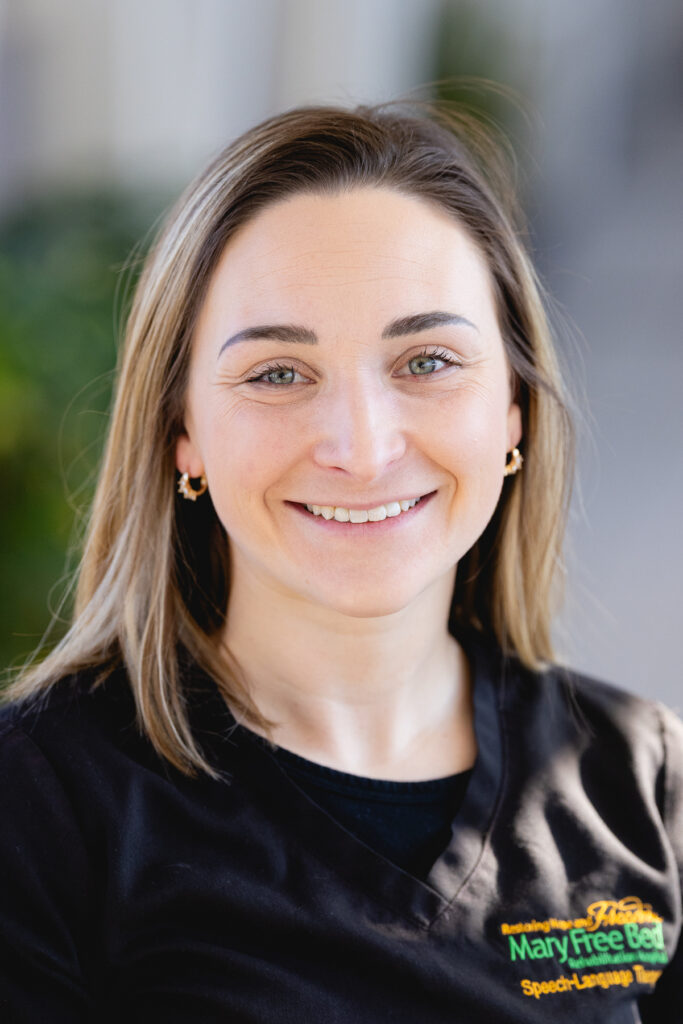
Jaimie Farrington is a speech-language pathologist and certified brain injury specialist. She has worked with Mary Free Bed Rehabilitation Hospital since 2017. Her clinical areas of expertise include cognitive-communication disorders, motor speech disorders, impairments in swallow function, and intervention that focuses on functional activities that assist people in returning to their highest level of independence following an acquired brain injury.